

Just Landed in Malaysia? Are You Quietly Worried: "Is Medical Care Reliable Here? Can Doctors Communicate Clearly? Will I Waste Money if I Feel Unwell?" Don't Worry! This Guide Will Help You Understand Malaysia's Medical "Hard Power," from Hospital Standards to Doctor Qualifications to Choosing Medical Services. After Reading, You’ll Feel Assured!
1.Here's a Confidence Booster: Malaysia's Healthcare is a Globally Recognized "Top Performer"
You don't need to do too much research; these key statistics say it all:
✅ International Rankings are Impressive: The World Health Organization (WHO) ranks Malaysia as the "49th best healthcare system globally," while the American magazine International Living rates it as the "best healthcare country in the world," ahead of many developed countries!
✅ Strong Hospital Infrastructure: Many hospitals in Penang and Kuala Lumpur have already passed "JCI International Medical Accreditation" (a globally recognized gold standard for healthcare quality), with at least 8 in the country! For instance, the "Asia Pacific's First National Heart Centre" handles heart issues and has successfully installed pacemakers for the "world's smallest children with congenital heart disease." Former Prime Minister Mahathir underwent two heart bypass surgeries here, ensuring high safety standards!
✅ Cost-Effective Services: Just compare and see how affordable it is— the same check-ups cost 1/2 of what they do in Singapore, 1/4 in Europe and America, and 1/5 in the UK. You won’t have to empty your wallet just to see a doctor.
2.Are the Doctors Reliable? Communication is Smooth + International Standards!
Worried about "talking past each other" during consultations? Concerned about doctors’ professionalism? You don't need to be anxious in Malaysia:
💡 Doctors are "Internationally Trained": Many doctors have been trained in Western countries like the US, UK, or Australia, possessing excellent skills and fluent English communication. Even better, both public and private hospitals have many Chinese-speaking doctors (especially in cities like Kuala Lumpur and Penang, where there is a large Chinese population). For consultations on colds, fevers, or chronic diseases, you can discuss your condition in Chinese without any need for gestures!
💡 Caring Medical Teams: Nurses and pharmacists are also very patient and thorough. When picking up medication, they will explain how to use it in detail. Even if you ask, "Can I take this with my medication from home?" they will provide careful answers without being dismissive.
3.Public vs. Private Hospitals: How to Choose What's Right for You? (With Comparison Table)
In Malaysia, healthcare is divided into "public" and "private," each with its advantages. Don’t stress; just choose based on your needs!
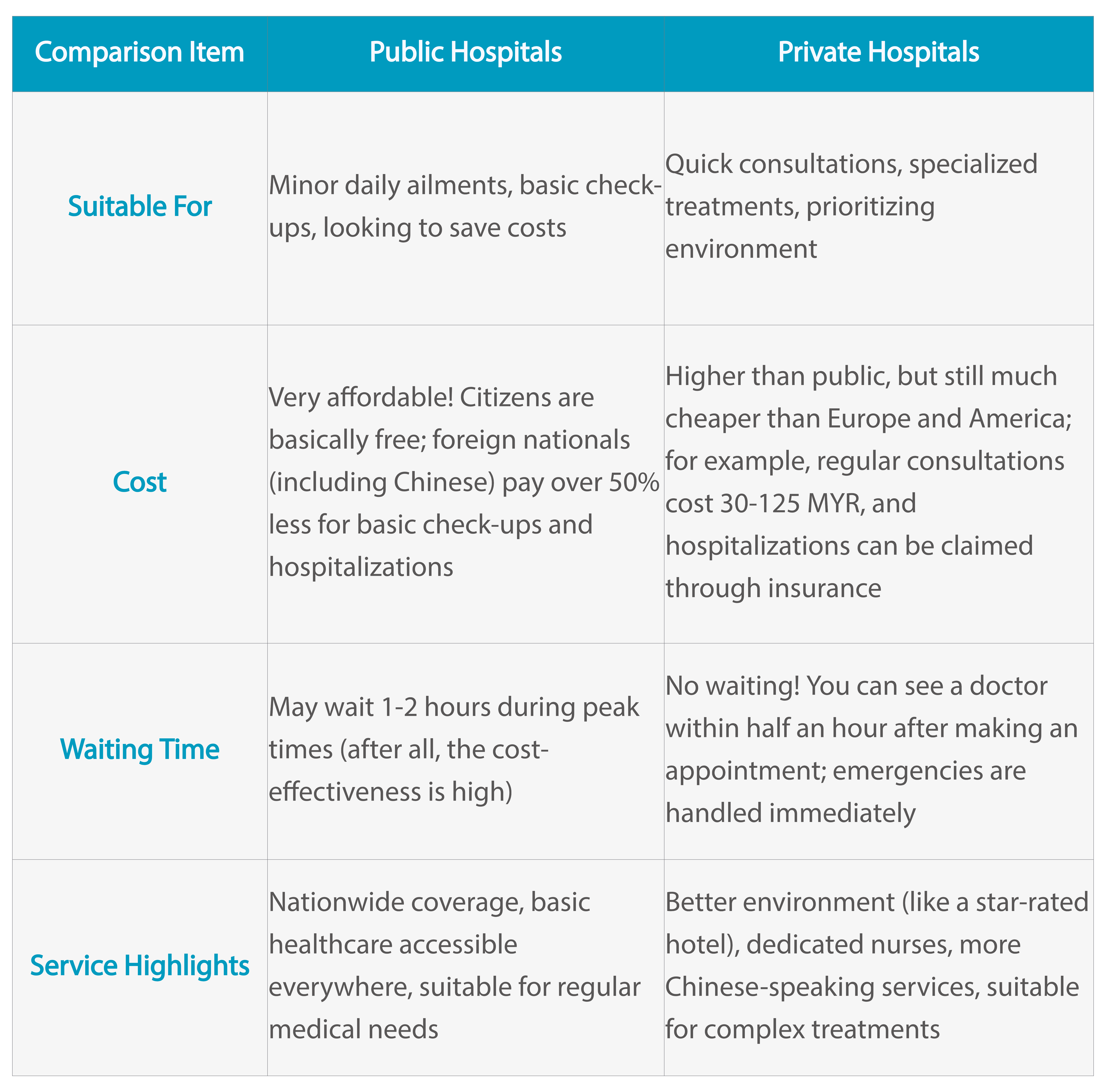
Example: If you have a cold and want to quickly get medication, choose a private clinic where a Chinese-speaking doctor can consult you and provide medication on the spot, all done in an hour. However, if you need a routine check-up, a public hospital offers better value, saving you half the cost!
4.Essential for Long-Term Residents: Health Insurance is a "Safety Net," Don't Skimp on It!
Many Chinese friends think, "I'm healthy, I don't need health insurance," but if you're living long-term in Malaysia, health insurance is essential:
- ✅ While private hospitals are great, if you face hospitalization or surgery, costs can range from thousands to tens of thousands of MYR. With health insurance, most of these expenses can be reimbursed, so a single illness won't "wipe out your hard-earned savings."
- ✅ How to Buy? You can look for local insurance companies (like Great Eastern or AIA) or purchase through your employer (many companies provide health insurance for foreign employees). When choosing, focus on "whether it covers hospitals commonly visited by Chinese and whether Chinese-speaking customer service is available" to avoid complications with claims.
- Note: If your whole family is staying long-term, make sure to get health insurance for the elderly and children as well, since health coverage should encompass everyone!
Stay Calm in Emergencies! Just Remember This Step
In case of sudden situations (like a persistent high fever or unexpected injury), don't panic—just call 999 (the emergency number in Malaysia). Clearly state your location (e.g., "I’m at XX Community in Kuala Lumpur") and your symptoms (you can speak in Chinese; the operator will arrange the appropriate assistance). Both public and private hospitals have 24-hour emergency centers. When you arrive, simply say, "I'm Chinese and need a Chinese-speaking doctor," and someone will assist you, so there's no need to worry about being neglected!
Final Reminder
Arriving in a new place can make "seeing a doctor" a source of anxiety. However, Malaysia's healthcare system has already taken "Chinese needs" into account—reliable hospitals, doctors who can communicate in Chinese, affordable costs, and an appropriate health insurance plan mean you don’t have to panic! I hope everyone stays healthy in Malaysia, and even if you occasionally feel unwell, you can easily resolve it!
Produced by Health Express Team
Content Development: Distinct Health Express Editorial Team
Professional Review: Distinct Health Express Medical Team
This article was initially drafted with AI assistance, refined by editors, and finalized following professional review by physicians.
This is original content by Distinct Healthcare, provided for informational purposes only and not intended as medical advice. For personalized guidance, consult a qualified physician.
Contact Email:health_content@distincthealth.com