

I. Scenario Introduction:
When you wish to return to China for continued treatment at a hospital abroad
Suppose you sustain an injury while traveling or working overseas. After undergoing surgery at a local hospital and stabilizing your condition, you wish to transfer back to a familiar hospital in China for rehabilitation. At this point, you need to initiate “non-emergency medical air transport.” The entire process will be centered around “safety and smoothness,” progressing step by step.
II. Step One: Initiate Transfer Request and Confirm Feasibility with Your Local Attending Physician
First, consult your attending physician to express your desire to return to China for continued treatment. Focus on confirming two key points:
・Whether your current condition is stable (e.g., wound healing, stable vital signs) and meets the criteria for “non-emergency transfer” (which requires no sudden risks and no need for en route emergency care);
・The approximate timeline for transport readiness (e.g., the doctor might say, “Observe for another week; if follow-up tests are clear, we can issue the certificate”).
III. Step 2: Coordinate with Insurance to Understand “How Much Can Be Covered and How”
This is a key concern for many. The crucial steps are “advance communication and gathering documentation”:
Contact your insurance company to find the customer service phone number listed on your policy. Explain your situation: “I am at XX Hospital in XX country and wish to fly back to my home country for post-operative treatment. I need to confirm whether this medical evacuation is covered by insurance and what documentation is required.” (Note: Travel insurance or medical insurance often covers “non-emergency medical evacuation,” but verify if it falls within the coverage scope—for example, check for exclusions like “post-operative evacuation overseas”).
Cooperate with the insurer for “liability determination.” The insurance company will request documentation, typically including:
・A medical statement from the local hospital (signed by a doctor, confirming stable condition and necessity for transfer)
・A detailed list of medical expenses (including any prior treatment costs if applicable)
・Your identification documents (passport, insurance policy) The insurer will review within days and inform you of: “eligibility for coverage” and “covered expenses” (typically including transport fees, onboard medical care, and ambulance transfer fees—specific coverage depends on policy terms).
Confirming insurance coordination methods: Some insurers directly recommend certified transport agencies they partner with. Alternatively, you may arrange transport independently and have the agency coordinate billing with the insurer to avoid upfront payment of large sums.
IV. Step Three: Prepare “Essential Documents”—Missing Any One May Delay the Process
Whether coordinating with transfer agencies or handling boarding and landing handoffs, these documents must be prepared in advance. It is recommended to make 2-3 copies and store electronic versions on your phone:
・Medical documents (core)
Complete medical records from the local hospital (including cause of injury/illness, test reports, surgical records, medication list);
“Flight Clearance Certificate” (issued by a physician, explicitly stating “The patient's vital signs are currently stable, suitable for commercial flight/medical charter transport, with no contraindications for air travel”—this serves as the “passport” for air transport and is mandatory for airlines);
・Recent follow-up reports (e.g., blood pressure, ECG, etc., taken 1-2 days prior to transport, confirming no change in condition);
・Documentation: Personal identification (passport, visa, ensuring sufficient validity);
・“Confirmation Letter” from the receiving hospital in China (contact the hospital in advance to obtain a letter stating “Agreement to receive the patient for continued treatment”; required by the transport agency);
・All materials required for insurance claims (copies, for submission after transport).
V. Step Four: Contact a Professional Medical Transport Team to Develop a Customized Plan
You can find them through these methods: insurance referrals, hospital recommendations (local hospitals may have partnered transport agencies), or verifying agency credentials (check for a “Medical Transport Business License” to avoid unlicensed small companies).
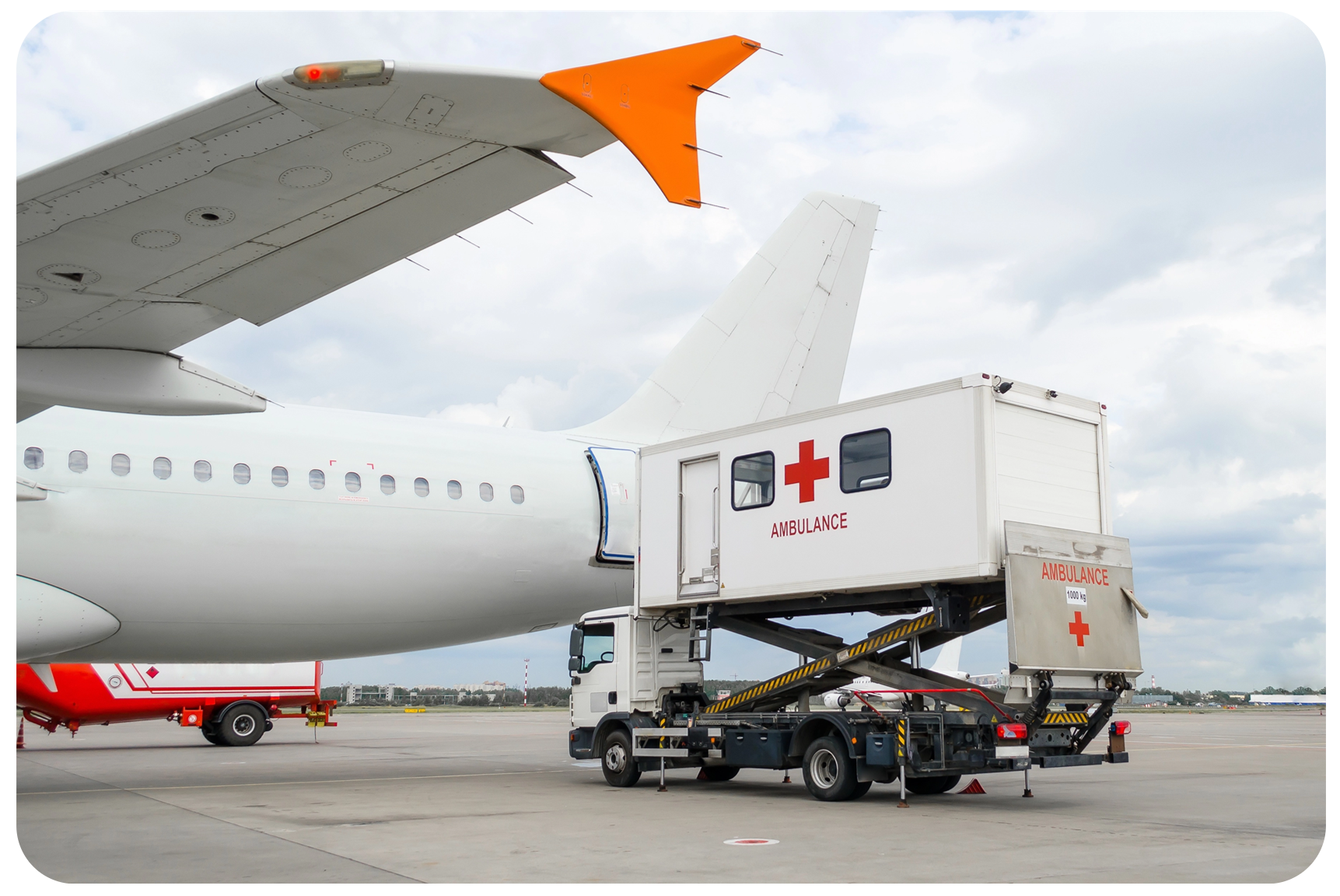
When contacting them, clearly state your situation (condition, current country/city, desired destination city in China, and specific needs). The agency will first assess whether they can handle the case. Work with the transport agency to finalize a detailed “transportation plan” covering every step, such as:
・Flight selection: If a fully reclining position is required, choose a business class seat that can be adjusted to lie flat. For special medical conditions (e.g., needing to bring medical equipment), they may coordinate a medical charter flight.
・In-flight arrangements: Determine if monitoring equipment or oxygen cylinders are needed, and whether an air rescue physician should accompany the patient throughout the journey.
・ Ground logistics: Transportation from the local hospital to the airport (ambulance with medical staff), application for airport “special passenger fast-track” (priority boarding), and ambulance arrangements from the airport to the receiving hospital upon arrival in China. Once finalized, the transfer agency will coordinate with: – Airlines (confirming flights and requesting in-flight medical support) – Local hospitals (coordinating discharge timing) – Receiving hospitals in China (confirming handover procedures).
VI. Step Five: Transport Implementation with Seamless Point-to-Point Coordination
This step requires minimal involvement from you—the transport agency will handle everything while you simply cooperate:
Hospital → Airport: Smooth Departure
・On the day of transport, the ambulance will arrive early at the local hospital for handover between medical staff and local doctors (confirming medical records and current condition);
・You will be safely transferred to the ambulance, with basic monitoring of blood pressure and heart rate during transit to ensure stability;
・Upon arrival at the airport, you will proceed through a pre-arranged priority lane, bypassing check-in and security queues. The medical team will handle your boarding procedures.
In-Flight: Continuous Medical Supervision
・After boarding, the medical team will assist with seat adjustments (e.g., reclining business class seat) and connect any portable medical devices (e.g., monitors);
・Regularly assess your condition during flight, such as taking blood pressure every 1-2 hours, and promptly address any discomfort (e.g., dizziness, wound pain);
・If a layover is required, medical staff will coordinate with the connecting airport in advance to arrange dedicated guides, minimizing your travel burden.
Domestic Arrival → Receiving Hospital: Seamless Handover
・Upon landing, a domestic ambulance will be waiting at the airport. Medical staff will assist you in transferring to the ambulance.
・The ambulance will transport you directly to the pre-arranged domestic hospital. The transport team will conduct a detailed handover with the receiving hospital's doctors: presenting all medical records, flight clearance documentation, and explaining the circumstances during transport.
・Upon completion, the transport agency will provide you with copies of all documents for subsequent treatment and insurance claims.
VII. Key Process Summary (Take Note!)
1. Confirm Medical Condition: Obtain a “Flight Clearance Certificate” from local doctors—this is essential for transport.
2. Coordinate Insurance Early: Clarify coverage scope and required documents beforehand to avoid out-of-pocket expenses.
3.Prepare all documents: Especially medical records, flight clearance certificate, and receiving hospital confirmation letter—missing any may delay the process;
4.Select a reputable agency: Check credentials and review plan details to ensure professional medical staff and seamless coordination throughout. By following this process, non-emergency medical air transport needn’t be stressful. The key is “prepare in advance and find the right professional help” to return home smoothly for continued treatment.
Produced by Health Express Team
Content Development: Distinct Health Express Editorial Team
Professional Review: Distinct Health Express Medical Team
This article was initially drafted with AI assistance, refined by editors, and finalized following professional review by physicians.
This is original content by Distinct Healthcare, provided for informational purposes only and not intended as medical advice. For personalized guidance, consult a qualified physician.
Contact Email:health_content@distincthealth.com