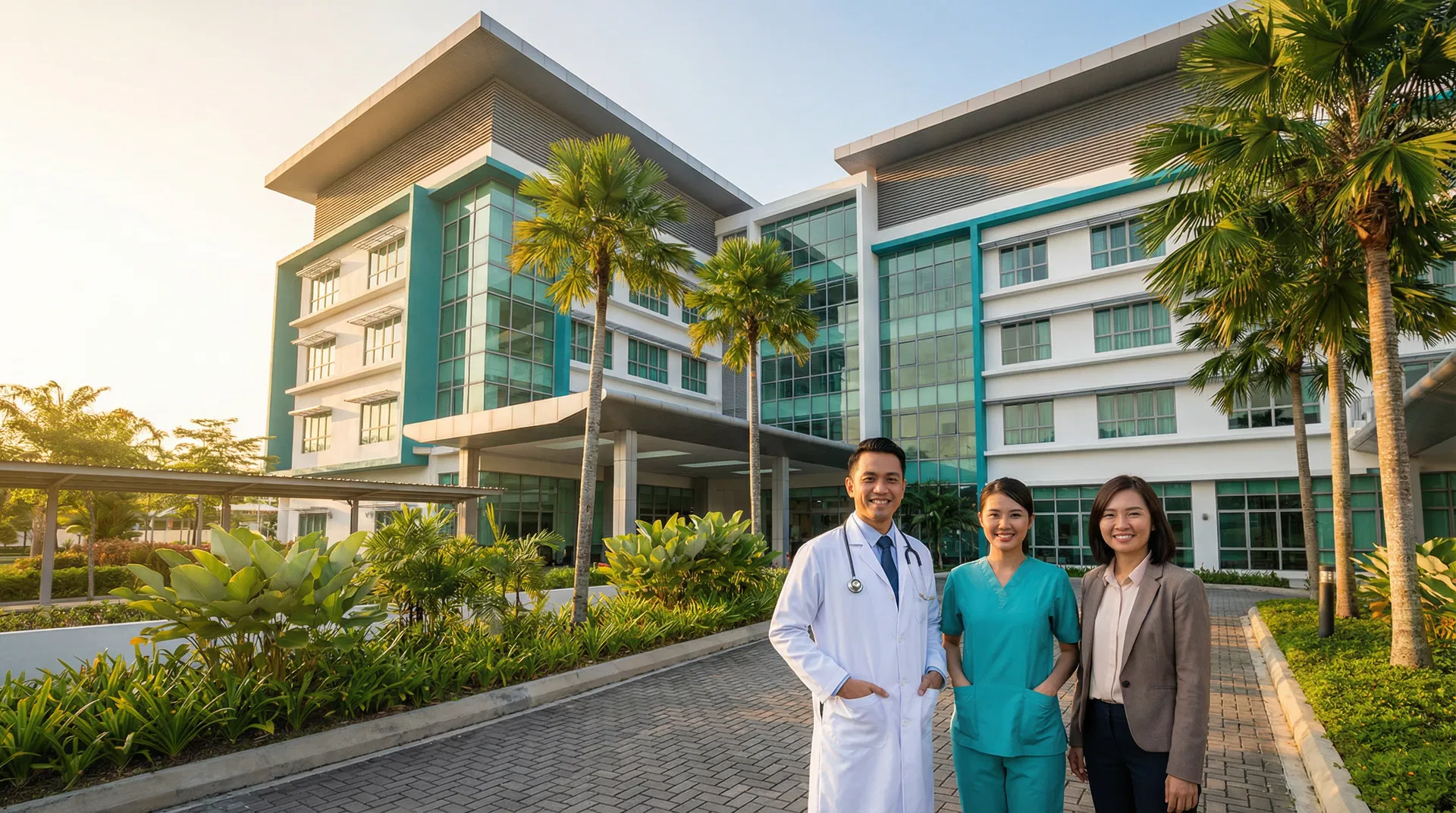
Three types of institutions — and how to choose the right one for your situation
Public, private, and charitable healthcare in Malaysia serve very different populations with very different cost profiles. This guide maps each option to the right resident type — foreign residents, international students, and short-term visitors — with practical guidance on insurance and emergencies.
Public · Private · Charitable — compared
Guidance by residency type
Insurance essentials · Emergency protocol
Arriving in Malaysia, many members of the Chinese community find themselves confronted with a range of options — government hospitals, private clinics, specialist centres, and charitable medical services — without a clear sense of which applies to them. This article starts by explaining the three distinct categories of Malaysian healthcare, then provides targeted guidance for the three most common resident profiles: foreign residents on work or long-term visas, international students, and short-term visitors. Insurance essentials and emergency procedures are covered at the end.
Ⅰ
Malaysia's Healthcare System: Three Distinct Categories
Understanding these three categories prevents costly mismatches between your situation and the care you seek
Category 1
Public Hospitals & Government Clinics
Fully government-funded; Malaysian citizens and permanent residents receive heavily subsidised care
Foreign nationals can access public facilities, but without subsidies — fees are charged at the foreigner rate, typically 5–10 times the citizen rate
Comprehensive specialist and surgical capacity; 24-hour emergency departments at major hospitals
General outpatient queues can be lengthy; A&E operates on triage — critical cases are prioritised
Foreigner reference cost A&E from ~MYR 100
Category 2
Private Hospitals & GP Clinics
Fully accessible to foreign nationals without residency status restrictions — the primary healthcare channel for most Chinese residents
Chinese-heritage doctors are well represented, particularly at GP clinics; Mandarin and Cantonese consultations are widely available
Short wait times: GP clinics typically see patients within 10–20 minutes of arrival
Selected hospitals hold JCI or MSQH accreditation, placing their clinical standards at an internationally benchmarked level
Reference cost GP clinic MYR 30–125
Category 3
Charitable Medical Organisations
Operated by Chinese community associations or non-profit organisations; primarily serve the Chinese community and economically disadvantaged groups
Offer low-cost or subsidised basic medical services in a Chinese-friendly environment
Limited in scope — generally cover basic outpatient care only, without inpatient or surgical capability
Most relevant for Chinese students or new arrivals with limited budgets and minor health needs
Reference cost Low-cost / means-based
Malaysia has 79 hospitals accredited by MSQH (Malaysian Society for Quality in Health — the country's highest domestic standard) and 8 hospitals with JCI accreditation (the internationally recognised gold standard). The overall quality of private hospital care is broadly comparable to Singapore and China's first-tier cities.
Ⅱ
Healthcare Guide for Chinese Residents: Choose Based on Your Visa Status
Three resident profiles, three distinct sets of recommendations — find your situation and apply directly
Foreign Residents (Work Visa / Dependent Pass / Malaysia My Second Home MM2H)
Minor illness
Go to a private GP clinic. Chinese-speaking doctors are widely available. Consultation fees range from MYR 30–80 and same-day appointments are the norm. Public clinics offer no subsidy for foreigners and involve longer waits — private GP clinics offer considerably better value.
Specialist care
Visit a private specialist hospital directly — no referral is required. Most specialists have received postgraduate training overseas and can consult in English or Mandarin. Consultation fees typically range from MYR 150–300 per visit.
Hospitalisation / Surgery
Choose a JCI-accredited private hospital (such as Gleneagles or Pantai Medical Centre). Notify your insurer in advance — many support direct billing, eliminating upfront payment. Costs are typically 50–75% lower than comparable treatment in Singapore; IVF, for example, costs approximately MYR 30,000.
International Students (Student Visa)
Insurance
Mandatory — arranged through the university at enrolment. Coverage includes hospitalisation and accidents; outpatient care is generally excluded and can be added via an optional outpatient rider. From 2025, the annual premium is MYR 800.
Seeking care
Minor illness: the on-campus clinic first (free); or an EMGS-recognised private GP clinic nearby. Serious illness: access private hospitals using your student insurance. Emergencies: call 999 for transport to a public hospital A&E (approximately MYR 100, reimbursable by insurance).
Short-term Visitors (Tourist or Social Visit Visa)
Minor illness / injury
Visit a private GP clinic — some operate 24 hours and can handle acute gastroenteritis, minor injuries, and common ailments. Cost is approximately MYR 50–150. Bring your passport for registration.
Emergency
Go directly to a public hospital emergency department — no appointment required. Foreign nationals pay a deposit of approximately MYR 100 on arrival; final charges are settled at discharge based on actual procedures performed. Travel insurance with medical coverage is strongly recommended before visiting.
Ⅲ
Insurance Essentials: Three Points That Matter
Particularly relevant for student visa holders and Malaysia My Second Home participants
Who Is Required to Hold Insurance?
Students
Mandatory purchase of a policy covering hospitalisation and accidents. Outpatient visits are generally self-funded; an outpatient rider can be added separately. From 2025, the premium is MYR 800 per year, arranged through the university.
MM2H holders
Health insurance documentation is required as part of the visa application. A comprehensive hospitalisation plan — covering surgery, medications, and related investigations — is recommended. Annual premiums range from approximately MYR 1,000–3,000, which is around 60% less than equivalent coverage in Europe or the United States.
Claims Process: Outpatient and Hospitalisation Follow Different Paths
Outpatient
Pay upfront, retain your medical report, itemised bill, and receipts, then submit to your insurer. Reimbursement is typically processed within 1–2 weeks.
Inpatient
Notify your insurer at least 24 hours before admission. Panel hospitals support direct billing — the insurer settles with the hospital directly, and you pay only any applicable co-payment at discharge.
MM2H
A comprehensive hospitalisation plan is the standard choice — covering surgery, medications, and pre- and post-admission investigations. This is the primary financial protection structure for families living long-term in Malaysia.
Ⅳ
Emergencies: Two Steps to Follow
Call 999, bring your passport — the hospital handles the rest
999
Malaysia national emergency number — ambulance, police, fire services. Chinese-speaking operators available.
1
Call 999 — free ambulance dispatch to the nearest A&E: Both public and private hospital ambulances respond. Critical cases receive priority treatment. State your location and symptoms in Chinese if needed; language is not a barrier.
2
Present your passport (or residence permit) at the emergency desk — two situations apply: Public hospital A&E: Foreign nationals pay a deposit of approximately MYR 100 on arrival; final charges are reconciled at discharge based on actual items. Private hospital A&E: No deposit required; costs are settled via insurance or self-pay. Wait times are generally shorter than at public A&E departments.
For urgent situations that do not require an ambulance, taking a taxi or ride-hailing service to the nearest private hospital A&E is often the fastest option. Walk straight in — the nursing team will triage you immediately.
Ⅴ
Four Practical Advantages for Chinese Patients in Malaysia
Concrete differences that become apparent once you are using the system
Language Accessibility
A substantial proportion of private hospitals and GP clinics have Mandarin- or Cantonese-speaking doctors, concentrated particularly in Kuala Lumpur, Penang, and Ipoh. Medical records can be requested in Chinese, making consultations broadly comparable in experience to seeking care at home.
Significantly Lower Costs
Equivalent medical procedures typically cost around 50% of Singapore prices and approximately 20% of US or European rates.
Reference prices: Dental scaling at a private clinic — approx. MYR 80. LASIK refractive surgery — approx. MYR 5,000. IVF treatment — approx. MYR 30,000.
Comfortable Inpatient Environment
Private hospital wards are spacious and well-appointed, with single-occupancy rooms routinely available. Chinese-speaking nursing staff are present at many facilities, and inpatient menus frequently include Chinese dietary options — congee, steamed fish, and other familiar dishes — which many patients find supportive during recovery.
Established Accreditation Framework
79 hospitals hold MSQH certification (Malaysia's highest domestic standard) and 8 carry JCI international accreditation. The clinical standards at accredited facilities are broadly comparable to those in Singapore and China's major cities.
Ⅵ
Quick Reference: Healthcare Options for New Chinese Residents
Match your residency type and scenario to the right recommendation
Foreign Resident Work / Dependent / MM2H
International Student Student visa
Short-term Visitor Tourist / social visit
Everyday illness
Private GP clinic MYR 30–80
On-campus clinic (first choice) or EMGS-recognised GP clinic Free / MYR 30–80
Mandatory — arranged via university MYR 800 / year from 2025
Travel insurance with medical cover recommended before visiting Purchase before departure
Three Principles That Cover Most Situations
1
For foreign residents, private GP clinics are almost always the right first stop. Public facilities offer no subsidy and involve longer waits for foreigners. For minor illness, everyday prescriptions, and specialist referrals, private clinics deliver better value, shorter wait times, and far greater language accessibility.
2
International students should exhaust on-campus clinic options first. Free, usually staffed by Chinese-speaking doctors, and minimal waiting time — the campus clinic is the most cost-effective starting point. If it cannot resolve the problem, the referral letter it provides facilitates seamless access to insurance-covered care at a designated hospital.
3
Short-term visitors must arrange travel insurance before arriving. Malaysian health insurance is valid only within Malaysia. Medical expenses incurred abroad — including emergency treatment during a visit — are fully self-funded without a travel policy in place.
Disclaimer & Credits
This article was initially drafted with AI assistance, refined by our editorial team, and finalised following professional review by Distinct Healthcare physicians.
This is original content by Distinct Healthcare, provided for informational purposes only and not intended as medical or insurance advice. Cost figures are indicative reference ranges; actual charges vary by provider and procedure. For personalised guidance, please consult a qualified physician or licensed insurance adviser.